
Private Jet Journeys: A Travel Advisor's Guide to Travelling the World by Air
Most of my clients can go anywhere they like. What they rarely have is time. That is why private jet journeys come up in my conversations more often each year: eight, ten, sometimes twelve extraordinary destinations across three weeks, with no airports to navigate, no security queues, no connections to miss, and no bags to handle. You leave your case outside your door in the morning and the next time you see it, it is standing in your room in the next country. You land, you are met, and you are taken straight to a hotel where everything is already waiting for you.
It is also the category I am asked to explain more than any other, and the one where I most often find clients working from the wrong assumptions. So here is what I tell them: what these journeys genuinely are, who runs them, what they cost, and, just as importantly, who they suit and who they do not.
If a journey like this has been on your mind, I would love to hear from you. Get in touch here.
First, an Important Clarification
Before anything else, let me clear up the misconception I correct most often, because it changes what you should be looking at entirely.
When most people hear private jet, they picture a Gulfstream or a Global Express, twelve seats, their own family and friends, departing when they like. That is a private jet charter, and it is a different product entirely.
A Private Jet Journey is something quite different, and I want you to know that before you fall in love with a brochure. They are operated on converted commercial airliners, typically an Airbus A321 or a Boeing 757, reconfigured so that a cabin built for 150 or more carries somewhere between 48 and 75 guests in lie-flat or first-class style seating. You are travelling with a group of strangers who become, over three weeks, something closer to fellow travellers. There is one meaningful exception, Aman, which I come to below, and it is the programme I reach for when a client wants the aircraft without the group.
Think of it less as chartering a jet and more as a small ship expedition cruise that happens to fly. The structure is remarkably similar: a fixed itinerary, a set departure date, expert guides and lecturers, a physician on board, a chef, curated excursions in every destination, and a group of forty-odd fellow guests who share the experience with you.
I am not saying this to put you off. For the right traveller it is genuinely wonderful, and my clients consistently tell me the company was among the best parts. But if what you actually want is your own aircraft, your own itinerary, and only the people you chose, then what you want is a charter, and I would rather tell you that now than after you have read six brochures.

Boarding a Private Jet Journey
The Operators Worth Knowing
TCS World Travel is the company behind a great deal of this category, and has been for roughly three decades. They operate their own expeditions for around 52 guests and also run the journeys for several other brands, which is why the aircraft may feel familiar from one programme to another. Their custom Airbus A321s were brought into service in recent years, operated by Titan Airways. The focus is on enrichment, with expert talks and immersive cultural access woven throughout.
Four Seasons Private Jet Journeys are sold and operated by TCS, and this is the hotel brand approach. You stay exclusively at Four Seasons properties, which if you love the brand is precisely the point, and the aircraft carries around 48 guests with an onboard lounge. Itineraries run roughly 16 to 24 days across destinations such as Tokyo, Bhutan, Bali, Easter Island, Machu Picchu, the Great Barrier Reef, and the Pyramids of Giza. This is where I send clients who want the most consistently polished experience in the category and who already know they love the brand.
Aman Jet Expeditions are the outlier in this category, and the one I find myself recommending more and more. Aman run these in partnership with Remote Lands, and the model is fundamentally different from everything else here. The aircraft is an Airbus ACJ 319 fitted with 19 seats in place of the usual 130, arranged as two large lounge-style cabins, and each expedition carries a maximum of 16 to 18 guests.
The part that matters most, though, is not the aircraft. On these journeys all touring is private. Every couple or solo traveller has their own car, driver, and guide in each destination, with a handful of shared group experiences woven in. You stay exclusively at Aman properties, and the itineraries run around three weeks. Recent expeditions have included a helicopter flight around Everest with a champagne breakfast at 14,000 feet, the hike to Bhutan's Tiger's Nest, and a private yacht through Phang Nga Bay.
This is the answer for the client who tells me they do not do group travel. You get the logistics and the aircraft without surrendering your days to a coach and a group departure time. At the time of writing, expeditions are priced from roughly $198,888.00 USD per person, so it sits at the very top of the category, and the guest numbers mean departures fill quickly.
Abercrombie and Kent were the genuine pioneers here, launching their first around the world journey back in 1989. They fly 48 to 50 guests on converted aircraft, and their strength has always been destination expertise and exceptional guiding, particularly in Africa. They also operate Small Jet Journeys for just 10 to 16 guests, which is a meaningfully different and far more intimate proposition, and one I raise with clients who find the larger groups off-putting.
National Geographic Expeditions take a different angle. Their journeys are built around themes rather than simply circling the globe, and they travel with National Geographic experts, explorers, and grantees. Their converted Boeing 757s carry around 75 guests. If what draws you is learning, marine biology, archaeology, anthropology, photography, this is the one I would point you toward. The intellectual content is the point rather than a bonus, and the clients who love it tend to be the ones who read the reading list.
Smithsonian Journeys belong in the same conversation as National Geographic, and are often overlooked. Their around the world expeditions carry the same scholarly weight you would expect from the Smithsonian, with study leaders travelling alongside the group, and recent itineraries have taken in French Polynesia, the Great Barrier Reef, Angkor, and the Taj Mahal. If your instinct is to learn as much as to look, this and National Geographic are the two I would put in front of you.
Adventures by Disney runs the only genuinely family-oriented programme in this category, and it is worth knowing about because nothing else comes close. Their Disney Parks Around the World private jet adventure visits all twelve Disney parks across six countries alongside the Taj Mahal, the Pyramids of Giza, and the Eiffel Tower, over roughly 24 days aboard a VIP-configured Boeing 757 with around 75 guests. Alongside the Adventure Guides there are Imagineers, Disney VIPs, and cultural experts, plus stays somewhere as rare as Summit Skywalker Ranch.
Two practical notes on the Disney programme. The minimum age is 12, with 14 and above generally recommended, and there is no reduced rate for children. It has also sold out repeatedly, so if it interests you at all, please come to me early rather than once you have decided. I organise these and I love them, particularly for multigenerational families where the grandparents want the Pyramids and the teenagers want Tokyo Disneyland.
If you are weighing one programme against another, I would be glad to help you work out which genuinely fits.
The Onboard Experience
The aircraft is not simply transport between destinations. On these journeys it functions as a kind of moving clubhouse, and it is where a good deal of the character of the trip is formed. Each operator fits out its aircraft differently, so I will use the Four Seasons jet as the benchmark here. It is the one clients ask me about most often, and it sets the standard the others are measured against.
The cabin. The aircraft is a custom-outfitted Airbus A321LRneo, a configuration that would normally seat over 200 passengers, fitted out instead with 48 seats. They are hand-crafted in soft Italian leather, arranged two by two in twelve rows, and each extends to a fully flat bed of roughly six and a half feet. Every seat has a plush ottoman, and these are deliberately designed so that a companion can sit facing you, which makes the cabin far more sociable than a conventional business class. The A321 also has one of the widest and tallest cabins in its class, so it does not feel enclosed.
The lounge. This is the feature that most distinguishes these aircraft. There is a dedicated social space in the middle of the cabin with a fully stocked bar, where guests gather, stretch their legs, and talk. Rotating food and drinks are served there, often themed to wherever you are flying next. Four Seasons also uses the lounge for workshops and demonstrations with their own craftspeople during flights, which is a lovely use of hours that would otherwise be dead time.
The dining. An executive chef travels with the journey for its entire duration, and the aircraft is fitted with a proper steam oven and custom refrigeration so meals are genuinely cooked on board rather than reheated. Four Seasons calls it the highest Four Seasons restaurant in the world, and having eaten at a good many of the ones on the ground, I think they have earned the line. Menus are developed in collaboration with the culinary teams at each hotel you are about to visit, so the food previews the destination. Flights of more than three hours typically include a full three-course service, and shorter hops still carry a meal.
Dietary requirements are handled properly here, which matters more to me than most things. I travel with a significant restriction myself, so it is one of the first questions I put to any operator, and the answer on these journeys is a good one. Menus are personalised, restrictions are taken seriously, and the chef will make you something entirely off-menu if that is what you want.
The crew. This is where the ratios tell the story. Alongside the flight crew there is a cabin team of around eight, meaning roughly one crew member for every six guests. There is an onboard concierge who travels the whole journey and can arrange things for you at the next destination while you are still in the air, a request at a hotel, a restaurant booking, a car. And there is a physician who travels with the group for the entire itinerary. On a route crossing eight or nine countries with wildly varying standards of medical care, this is the detail I find reassures clients most once I mention it, and almost nobody thinks to ask about it beforehand.
The details. Guests are typically welcomed aboard with slippers, a leather and fabric tote, and an amenity kit from a luxury house. Unlimited Wi-Fi is included throughout, along with tablets loaded with entertainment and destination material, and power at every seat. The lavatories are considerably larger than anything you will find on a narrow-body aircraft and double as changing rooms, with a full-length mirror and a bench.
One point I always make to clients. These itineraries are deliberately built so that flights are daytime segments of manageable length, generally arriving mid-afternoon. You are not enduring ultra-long-haul sectors. That sequencing is a large part of why the pace is sustainable at all, and it is the thing I would credit the operators with most.
How the other operators compare. Abercrombie and Kent fly an all-first-class Boeing 757 for 48 to 50 guests. National Geographic use a converted 757 for around 75, and their crew includes expedition leaders, subject experts, and often a staff photographer, which suits the enrichment focus of their programmes. Adventures by Disney charter a VIP-configured 757 with Adventure Guides, Imagineers, and cultural experts alongside the chef and physician. TCS operate their own A321neos for around 52 guests with a travelling staff of roughly eighteen. Aman sit apart from all of them, flying an Airbus ACJ 319 with just 19 seats in two lounge-style cabins for a maximum of 16 to 18 guests. The aircraft differ, but the essential model is consistent: a large cabin thinned out dramatically, a chef, a physician, and a team that travels with you throughout.
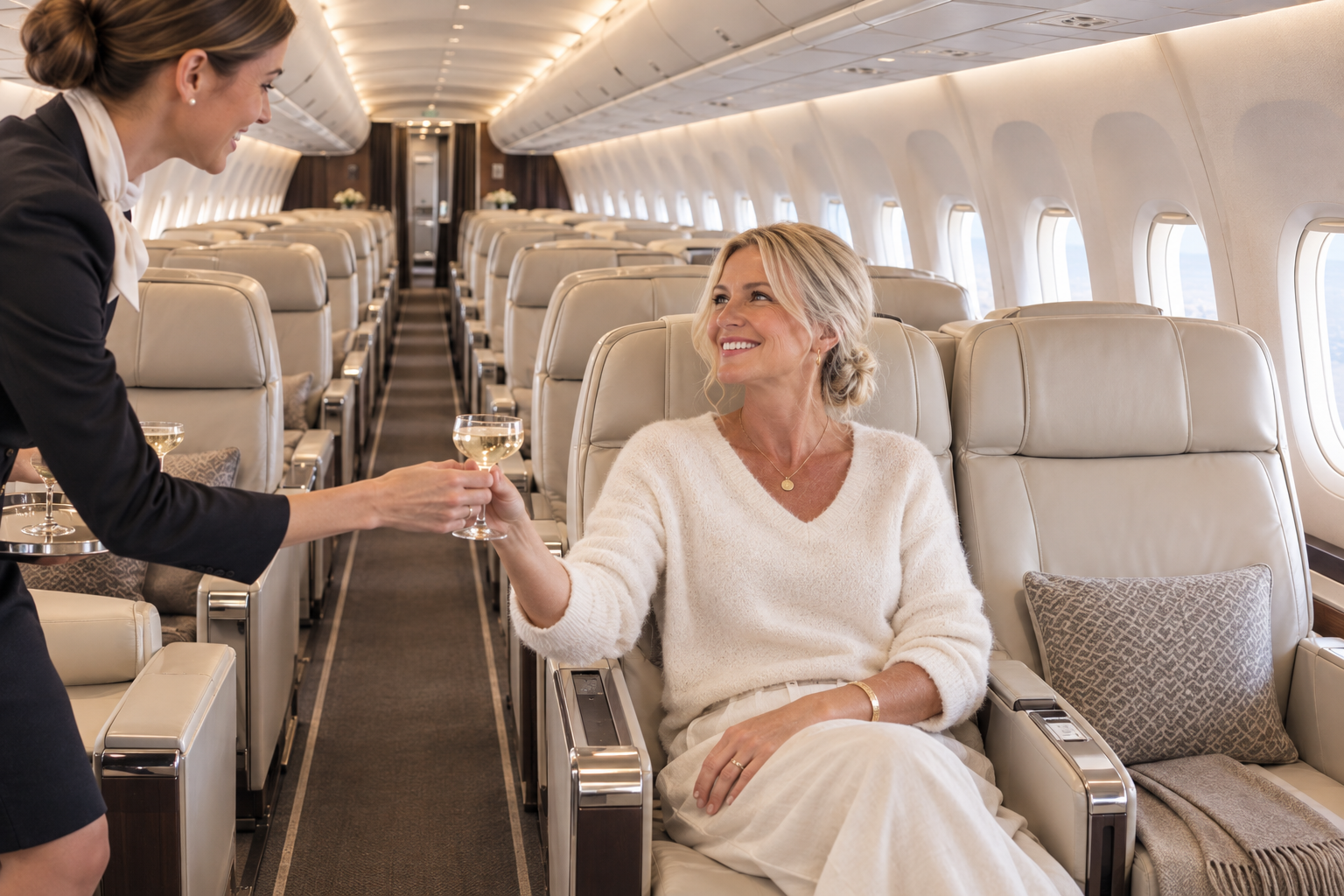
Most Private Jet Journeys are All Inclusive, onboard and on the ground.
What a Day Actually Looks Like
The rhythm is more structured than most people expect, and in my experience it is the single best predictor of whether someone will love this style of travel or find it exhausting. So rather than describe it in the abstract, here is what a typical day actually looks like.
A Flying Day
This is the day that makes these journeys distinctive, and it bears very little resemblance to commercial travel.
6:30am. Your bags need to be outside your hotel room door. This is the one piece of discipline the whole operation depends on, and it is taken seriously. From here your luggage is collected, transported, cleared, and placed in your next hotel room without you seeing it again until that evening.
7:00am. Breakfast at the hotel, usually a private room or a reserved section set aside for the group. Coffee, a quiet start, and the day's programme confirmed.
8:15am. Group departure for the airport by coach or private car, depending on the programme and the destination.
8:45am. You arrive at a private aviation terminal, not the main airport building. There is no check-in desk, no queue, no chaotic security theatre. Passports are collected and processed as a group, while you are having a coffee in the lounge. On many departures you walk straight across the tarmac and up the stairs.
9:30am. Wheels up. The cabin is configured for roughly 48 to 75 guests in lie-flat or first-class style seating, so there is real space. A chef prepares meals on board rather than reheating trays. There is often a lecture during the flight from one of the resident experts, an archaeologist, a naturalist, a historian, preparing you for where you are landing. Otherwise you sleep, read, or talk to the people who by week two have become genuinely good company and friends.
1:30pm. You land. Immigration is handled on the tarmac or in a private lounge, as a group, usually in a matter of minutes. This is the moment most guests say they understood what they were paying for.
2:30pm. Arrival at your hotel. Rooms are pre-assigned and keys are waiting. Your luggage is already on the luggage racks in your hotel room.
4:00pm. An orientation walk or a gentle first excursion, pitched deliberately light because everyone has been travelling.
7:30pm. A welcome dinner, often somewhere notable, a rooftop, a private courtyard, a historic house. Expect a briefing on tomorrow's options and departure times.
A Full Day in Destination
7:00am. Breakfast. Some guests are up at dawn for an optional sunrise excursion, a hot air balloon, a temple before opening hours, or a market as the vendors set up.
8:30am. Excursion departure. You will usually have chosen from two or three options the evening before, graded by pace. A gentle morning might be a museum with a curator. A standard option might be a guided city tour. An active option might be a hike, a bike ride, or a climb.
1:00pm. Lunch, sometimes as a group at a restaurant that has been taken over for you, sometimes free to your own devices.
3:00pm. An afternoon excursion, or genuinely free time. This is the portion that varies most between operators and destinations, and it is one of the things I check on your behalf before recommending a departure, because some itineraries leave far more free time than others.
6:30pm. An expert talk or a cocktail reception before dinner.
8:00pm. Dinner, frequently a private event. This is where these journeys earn their reputation: a palace opened after hours, a private collection, dinner beneath a monument closed to the public, a performance arranged solely for your group.
The pattern repeats, with two to three nights in each destination before the next flying day. It is a full rhythm and a genuinely exhilarating one, and knowing it in advance is the best way to judge whether it suits you.
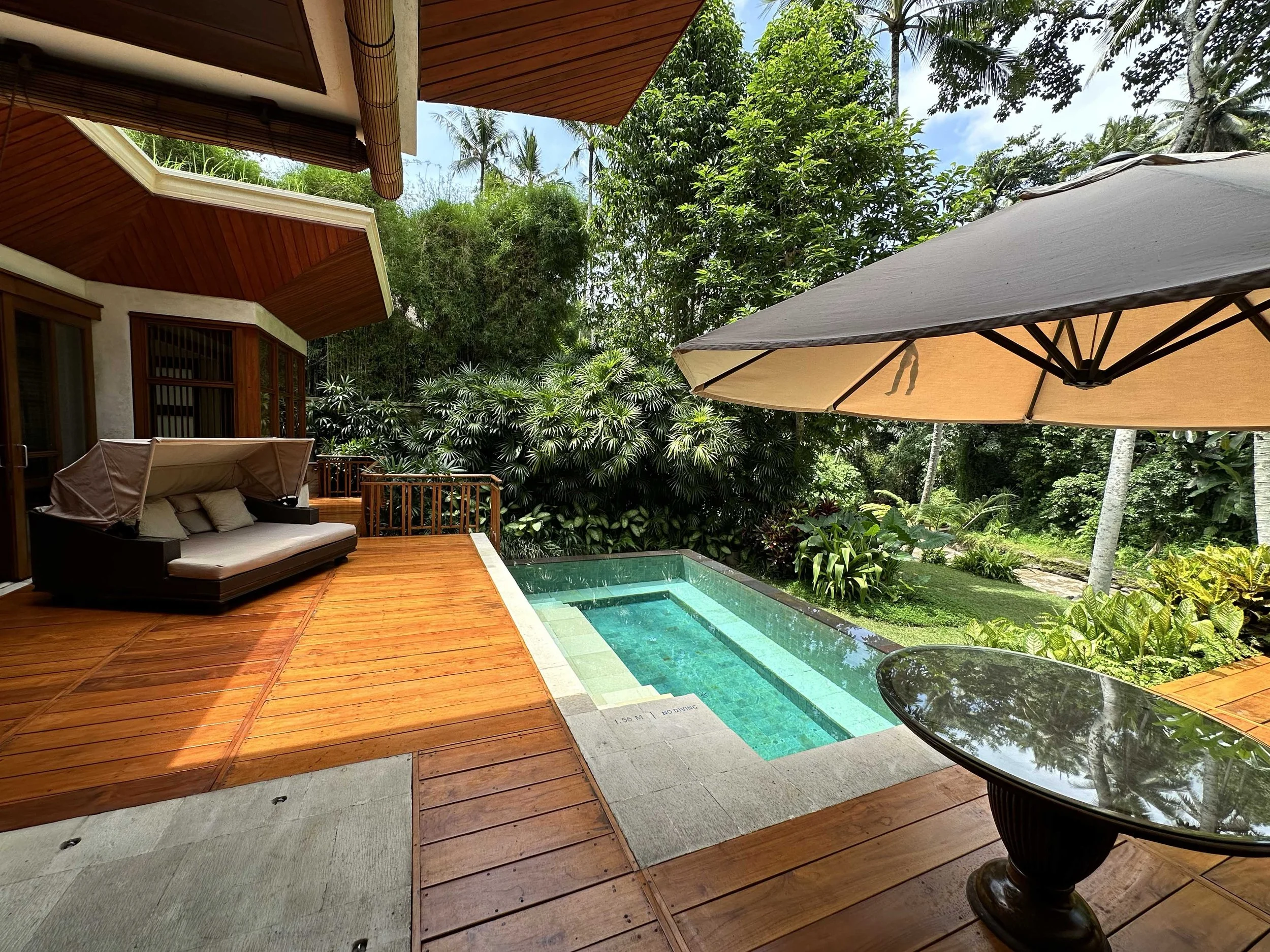
Riverside One Bedroom Villa at Four Seasons Resort Bali at Sayan. One of the popular, included stays with the Four Seasons Jet itineraries to Bali.
What I Tell Clients Before They Book
Every brochure in this category is glorious, and I would rather you heard the rest from me than discovered it on day nine. None of what follows should stop you going. It should simply shape which programme you choose.
The pace is full, though perhaps not in the way you are imagining. Twenty-four days, ten destinations, early starts most mornings. When I ask clients how it went, the answer is almost always that it was extraordinary and that they would have liked longer in one or two places.
But I want to be fair here, because this is often held up as a criticism and I am not sure it deserves to be. Any well-designed land itinerary covering this much ground is equally busy, and usually harder work. On a comparable trip by scheduled airlines you would lose entire days to airport transfers, check-in queues, security, immigration halls, baggage carousels, and connections that may or may not hold. The jet journey removes all of that friction. My clients come home tired, certainly, but generally less frayed than they would from an itinerary of similar scope arranged any other way.
What the pace does mean is that this is not a holiday in the resting sense. If what you want is unstructured time and long lazy mornings, I will say so honestly and suggest something better suited. If what you want is to see a great deal of the world without wasting a single day on logistics, this is close to the most efficient way it has ever been done.
Jet lag is real, and worth planning for. You will cross a great many time zones over three weeks, and no amount of luxury changes what that does to your body.
The good news is that these itineraries are designed with it in mind rather better than most people realise. Flights are daytime segments of manageable length, usually arriving mid-afternoon, so you land in daylight and can sync to local time immediately. Lie-flat seats mean that if you do need to sleep on a sector, you can sleep properly. Arrival days are deliberately light, with an orientation walk rather than a full excursion, and there is a physician on board if you struggle.
What I advise clients is to arrive a day or two early into the departure city and adjust before the journey even begins, to be disciplined about daylight and hydration in the first week, and to take at least one of the optional free afternoons genuinely free rather than filling it. Those three things make a considerable difference, and I build the pre-trip days into the arrangements as a matter of course.
The luggage situation catches almost everyone out. The main aircraft handles your bags without issue, but several itineraries include shorter connecting flights on smaller aircraft that cannot carry the same weight, and in some destinations you may be limited to a carry-on for a couple of days. Clients have been told at short notice, sometimes late in the evening, that only one small bag is coming to the next destination for the following few days. There is a great deal of repacking on these journeys, and nobody puts it in a brochure. It is one of the first things I brief my clients on, because knowing it before you pack changes what you bring entirely.
Itineraries and aircraft can change without much notice. Geopolitics, weather, and airport limitations all intervene. A recent journey dropped Jordan entirely and rerouted to India when conflict broke out, and the replacement days turned out to be a group favourite. Occasionally the aircraft itself changes for a leg of the journey, because a number of the most desirable destinations simply cannot take an aircraft of that size. Bhutan is the classic case. Paro is ringed by Himalayan peaks with a short runway and a notoriously demanding approach, flown only by a small number of specially certified pilots, so guests transfer to a smaller regional aircraft for that portion. The same applies at various island and high-altitude airports across these itineraries. These operators handle disruption better than almost anyone in travel. They are simply not immune to the world, and I would rather you booked knowing that.
You will probably have been somewhere on the itinerary already. This is the one genuine sticking point for my most travelled clients. These itineraries are fixed and beautifully built, but if you have already spent time in Marrakech or at the Taj Mahal, you go anyway. You can always opt out of a day and do something of your own, and clients often tell me that returning somewhere with this level of access felt entirely different. Still, it is worth weighing before you commit.
You are travelling with a group. Meals, excursions, and departure times are largely communal. Most of my clients come home having made real friendships, and the company on these journeys is genuinely interesting. But if you travel to be alone with your partner, tell me that early. It does not rule out a jet journey, it simply points you toward Aman, where the touring is private, or toward Abercrombie and Kent's smaller aircraft, or toward a charter.
None of this is a reason not to go, and I would happily send most of my clients on one. It is simply why I ask the questions I do before recommending a programme, because the right one for you is rarely the one with the prettiest brochure.
What to Pack, and What to Wear
Given the luggage constraints above, packing well matters more on these journeys than on almost any other trip you will take. Here is what I tell clients.
Pack layers. One itinerary can take you from the Himalayas to the tropics in under two weeks. Thin layers you can add or remove work far better than heavy pieces, and they mean one suitcase can handle a cold morning at a mountain monastery and a hot afternoon on the coast.
Comfortable walking shoes are the single most important thing you will pack. The operators say this themselves, and they are right. You will be on your feet daily, often on uneven ground, at sites where the surface has not changed in eight hundred years. Bring two pairs so you can alternate.
Bring a few nicer outfits, but leave the black tie at home. There is no formal dress code on any of these journeys. Guests do tend to dress up a little for the welcome and farewell dinners, though it is entirely optional, and several of the hotels have more formal dining rooms where you will feel better in something smarter. Elegant and easy is the standard throughout.
Pack lighter than instinct suggests. Laundry service is available at most of the hotels on these itineraries, which solves a great deal. And given the repacking that the smaller connecting flights require, a case you can genuinely manage is worth more than one that holds everything.
Leave room for what you buy. Three weeks across eight or nine countries, with private shopping access in several of them, and most guests come home considerably heavier than they left.
Each operator sends a detailed packing list closer to departure, tailored to your specific itinerary and season, and I go through it with clients rather than leaving them to interpret it alone.
Visas, Vaccinations and the Practical Side
A journey crossing eight to ten countries raises questions that a single-destination trip does not, and this is an area where these programmes are genuinely well organised.
I remain your point of contact throughout, from our first conversation to the day you return home. Alongside me, the operator assigns a dedicated guest services manager well before departure, and I work directly with them on your behalf. Between us we make sure your preferences are recorded and acted on, that you know which vaccinations are required or recommended for your specific routing, that the packing list makes sense for your itinerary, and that any customisations you would like are arranged. You should never need to chase anyone or repeat yourself. That is my job, not yours.
Visas are generally handled with support from the operator, and for many destinations the group arrangement simplifies things considerably. Some still require action from you well in advance, so this is not something to leave until the month before.
Vaccinations depend entirely on the routing, and I would always recommend a conversation with a travel medicine clinic four to six weeks out rather than relying on general advice.
Travel insurance is not optional in my view on a journey of this value. I go through the policy with clients rather than assuming, particularly the cancellation and medical evacuation provisions.
A few small things that tell you the standard. The better operators provide local currency at every stop so you are never caught without it, unlimited bottled water throughout, and, my favourite detail, postcards that you write and they mail for you. None of this is why you book, but it is a fair indication of how thoroughly the rest has been thought through.
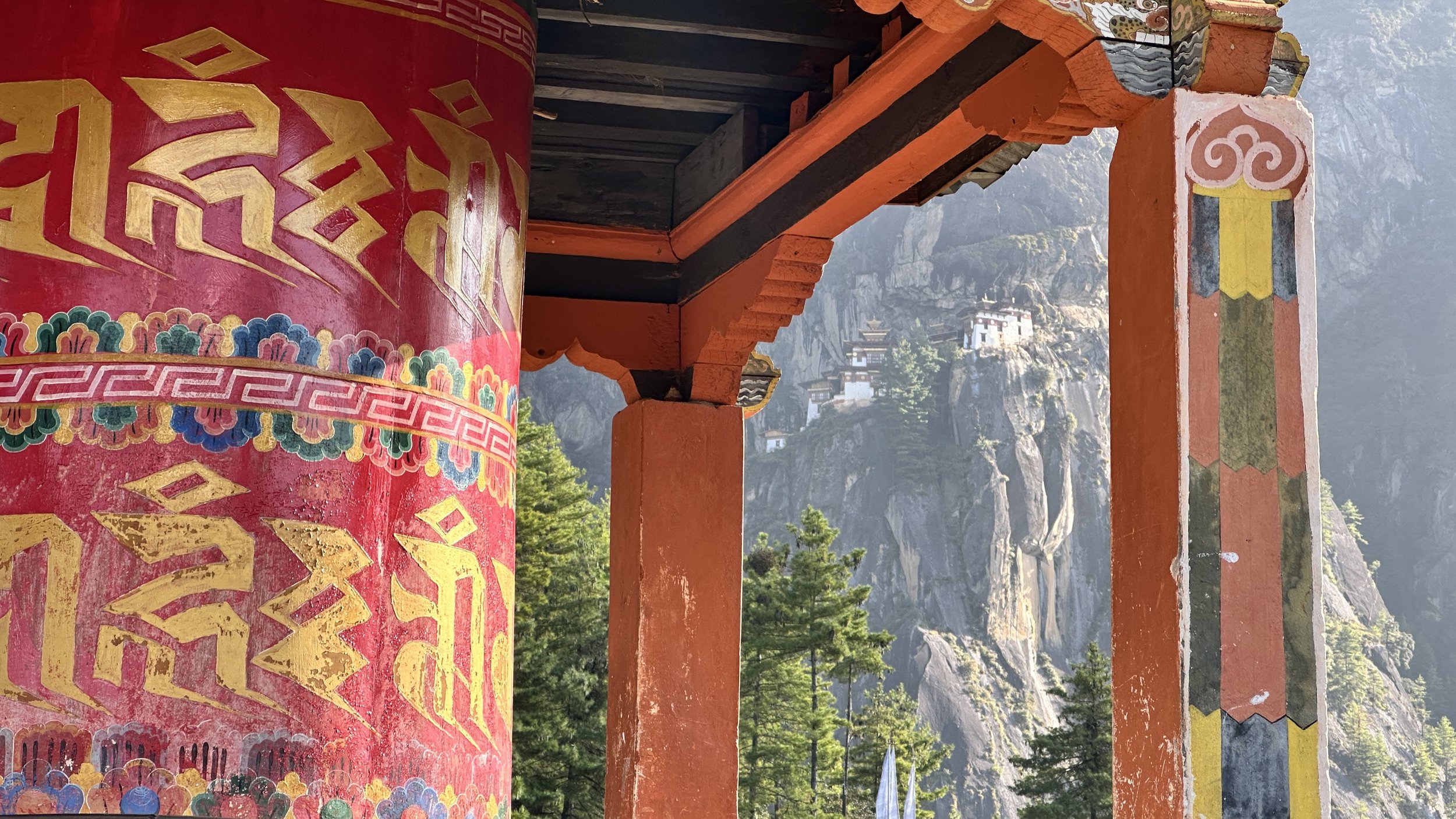
Tiger’s Nest perched high above the valley floor near Paro, Bhutan
The Charter Alternative
If everything above appeals except the group, there is another route, and most people do not realise it exists yet.
Four Seasons has begun offering full charters of its private jet, setting aside blocks of time for guests who want to design their own itinerary with their own people. At the time of writing, a charter for up to 48 guests with a crew of ten starts from around $115,000.00 USD per day, with accommodation, transfers, meals, touring, and entry fees arranged separately on top.
That is a significant investment, but for a milestone birthday, a landmark anniversary, a multigenerational family gathering, or a group of friends who want to travel together properly, it changes the calculation entirely. You choose the destinations, you choose the pace, and every seat is filled by someone you invited.
There is useful middle ground before you get to a full charter. Aman's expeditions carry 16 to 18 guests with entirely private touring, and Abercrombie and Kent's Small Jet Journeys carry 10 to 16, which also opens up airports the larger aircraft simply cannot use. For many of my clients, one of these turns out to be the right answer rather than a completely private charter.
If a private charter for your family or group is something you are considering, this is exactly the sort of journey I love to design. Let us talk about it.
Understanding the Investment
Private jet journeys sit among the most significant investments in leisure travel, and the range is wide.
At the time of writing, National Geographic's themed expeditions generally begin in the region of $90,000.00 USD per person. Abercrombie and Kent's around the world journeys typically run from the low six figures upward depending on length and itinerary. The Adventures by Disney programme has been priced around $110,000.00 USD per person. Four Seasons Jet journeys sit higher, frequently well above $130,000.00 USD per person. Aman Jet Expeditions sit at the very top, from roughly $198,888.00 USD per person, which reflects the small guest numbers and the entirely private touring.
Several things are worth understanding about how this pricing works.
Nearly everything is included, which is genuinely unusual at this level. Flights throughout, accommodation, most meals, all excursions, guides, gratuities to guides and drivers, and the onboard team including a chef and a physician.
Single supplements vary considerably, and this is worth asking about rather than assuming. Some programmes are genuinely solo-friendly, with supplements calculated as a modest percentage of the fare. Others run well into five figures. If you are travelling alone, tell me early and I will steer you toward the departures that treat solo travellers best, because the difference between operators here is significant.
Your international flights to the departure city are usually separate, as are travel insurance, personal purchases, and anything you arrange independently.
Pricing shifts with each season's programme, so rather than quote figures that go stale, I give clients current numbers for the specific departures they are weighing up. What I will say plainly is that these sell out a year or more ahead, and the best departures go first. If something here has caught your attention, the time to raise it with me is now rather than next spring.
Who These Journeys Genuinely Suit
I would recommend one to you if time is your scarcest resource and you want to see a great deal of the world without wasting any of it. If you enjoy the company of interesting people. If you value expert guiding and access you could not arrange yourself. If the logistics of a complex multi-country trip are precisely what you want handed to someone else. And if you are in reasonably good health, because the pace does ask something of you.
I would steer you away if you want unstructured time, if you prefer to travel only with your own party, if you have already visited much of the itinerary, or if you would rather spend a week somewhere properly than two days somewhere remarkable. There is no shame in any of that, and there are better ways to spend the same money.
There is a third option I raise with clients surprisingly often, which is to visit the same destinations on a private, bespoke itinerary I build entirely around you, at your own pace and with your own guides. It usually costs less, every day of it is yours to shape, and you can stay as long as you like in the places that matter most to you. The trade-off is time. Without a dedicated aircraft you are relying on commercial flights, so covering the same ground takes considerably longer, and most clients choosing this route end up doing it in stages over a few years rather than in one three-week stretch.
Plenty of my clients come to love that approach. Each journey becomes its own chapter, planned with real anticipation, and they return to places properly rather than passing through. Others want to see the world now, in one extraordinary sweep, and a jet journey is exactly right for them. There is no wrong answer, only the one that fits your life.
Deciding between the two is one of my favourite conversations to have. I would love to hear what you are considering.
Frequently Asked Questions
Is a private jet journey actually a private jet? Not in the way most people mean it, and this is the question I answer most often. These journeys use converted commercial airliners, usually an Airbus A321 or Boeing 757, reconfigured to carry between 48 and 75 guests in lie-flat or first-class seating. You share the aircraft with other guests. If you want an aircraft exclusively for your own party, that is a charter, which is a different arrangement entirely and something I can also organise for you.
How long do these journeys last? Most run between 16 and 26 days. The classic around the world itineraries tend toward 20 to 24 days, while regionally focused journeys can be shorter.
How much does a private jet journey cost? Broadly from around $90,000.00 USD per person at the more accessible end, up to roughly $200,000.00 USD per person for Aman's small-group expeditions, with single supplements often running into five figures. Nearly everything is included once you are travelling. Pricing changes each season, so ask me for current figures on the departures you are considering.
What is included? Generally all flights during the journey, accommodation, most meals, excursions, expert guides, gratuities to guides and drivers, and the onboard team including a chef and physician. Your flights to the starting city, travel insurance, and personal expenses are usually separate.
What is the aircraft actually like inside? Far roomier than you might expect. A cabin built for 200 or more passengers is reconfigured for 48 to 75 guests in lie-flat or first-class seating, with a social lounge and bar in the middle of the aircraft, considerably larger lavatories that double as changing rooms, unlimited Wi-Fi, and power at every seat. It feels closer to a private club than a commercial cabin.
Is the food actually cooked on board? Yes. An executive chef travels with the journey and the aircraft carries a proper steam oven and refrigeration, so meals are prepared in the air rather than reheated. Menus are often developed with the culinary teams at your next destination, and dietary requirements are handled carefully and personally.
Is there a doctor on board? Yes, on all the major programmes, and I always mention it because it reassures people far more than they expect. Crossing this many countries and time zones, having a doctor travelling with the group matters.
Can children come? On most programmes these journeys are adult-oriented. The exception is Adventures by Disney, which is purpose-built for families, though the minimum age is 12 with 14 and above generally recommended, and there is no reduced rate for children.
What should I pack? Layers above all, because a single itinerary can span the Himalayas and the tropics. Comfortable walking shoes are genuinely the most important item, and bring two pairs. A few smarter outfits are useful for the welcome and farewell dinners and the more formal hotel dining rooms, but there is no formal dress code and no need for black tie. Pack lighter than instinct suggests, as laundry is available at most hotels, and leave room for what you buy. A detailed packing list arrives closer to departure and I go through it with clients.
Do I need visas and vaccinations? Usually some of both, depending on your routing. The operators provide considerable support with visas and advise on vaccinations for your specific itinerary, and a dedicated guest services manager is assigned before departure. I coordinate with them directly on your behalf, so you deal with me rather than juggling contacts. I would still recommend a travel medicine clinic appointment four to six weeks ahead.
How far in advance should I book? A year or more is normal, and the most popular departures sell out very quickly. The Disney programme in particular has sold out repeatedly. If a specific departure matters to you, come to me as early as you can.
How do you handle the jet lag? Better than you would expect. The itineraries use daytime flights of manageable length, usually landing mid-afternoon, so you arrive in daylight and adjust quickly, and the lie-flat seats mean you can genuinely rest on a sector. Arrival days are kept deliberately light. I also recommend arriving a day or two early into the departure city and building in a properly free afternoon or two along the way, and I arrange those extra days for clients as standard.
How fit do I need to be? More than people assume, and I would rather be straight with you about it. Early mornings, long days, a good deal of walking, often over uneven ground, and repeated time zone changes. The operators grade excursions by activity level and you can always take a day off, but the overall rhythm is demanding. If mobility or stamina is a consideration for anyone in your party, tell me at the outset and we will look at this carefully together.
Can I skip destinations I have already visited? Not usually, and if you are well travelled this is worth thinking about seriously before you commit. The itineraries are fixed. You can opt out of individual excursions and spend the day as you please, but the routing does not change. This is often the point at which I suggest a client consider a bespoke private itinerary instead.
What happens if the itinerary changes? Occasionally it does, for reasons of geopolitics, weather, or airport limitations. The operators reroute quickly and generally very well. It is also one of the reasons I insist on comprehensive travel insurance for a journey of this value, and why I go through the fine print with clients rather than leaving it to chance.
I do not enjoy group travel. Is there an option for me? Yes, and this is worth knowing before you dismiss the category. Aman Jet Expeditions carry only 16 to 18 guests and, crucially, all touring is private, with your own car, driver, and guide in every destination. Abercrombie and Kent also fly smaller aircraft for 10 to 16 guests. Beyond that there is full charter. You do not have to choose between a coach full of strangers and doing it all yourself.
Can I charter the whole aircraft for my own group? Yes, and this is one of my favourite things to plan. Four Seasons now offers full charters for up to 48 guests with a bespoke itinerary, and Abercrombie and Kent operate smaller aircraft for 10 to 16 guests. For a landmark birthday, an anniversary, or a multigenerational family journey, it is a remarkable way to travel, and every seat is filled by someone you invited.
Let Me Help You Plan Your Journey
A private jet journey is among the most extraordinary ways to see the world, and among the most significant investments you will ever make in travel. Choosing the right programme, or deciding that a private charter or a bespoke itinerary would serve you better, is not a decision to make from a brochure. It is the sort of thing I am here to talk through properly, and there is no obligation in asking.
I am a travel advisor specializing in luxury and bespoke travel, and a proud member of Virtuoso. Get in touch with me here and tell me what you have in mind. I read every enquiry personally, and from there we will arrange a time to talk it through properly.
Safe travels,
Ariane